In the ever-evolving landscape of EA Sports FC 25's Ultimate Team, the quest for a competitive edge often begins with a single, crucial decision: the shape on the tactical board. 👟 Each new edition of the football simulation brings seismic shifts, and this year is no exception, with formations recalibrated to embrace novel player roles and positional dynamics. The pitch becomes a canvas, and the chosen formation is the first, bold stroke of a manager's masterpiece. It is a declaration of intent, a framework upon which victories are built and dreams are dashed. Some tactical blueprints whisper of patient, possessive control, building attacks like a symphony. Others scream of ruthless, lightning-paced counter-attacks, a blitzkrieg on grass. Understanding the soul of each formation—its rhythm, its demands, its hidden vulnerabilities—is the foundational art of the modern virtual manager.
The 4-4-2 stands as a timeless monument in the footballing pantheon, a formation woven into the very heritage of the sport. Its beauty lies in a profound equilibrium, offering a serene balance between defensive fortitude and offensive breadth. It allows for the poetry of quick transitions, where defense flows into attack in one fluid motion. Two strikers dance in tandem at the apex, their partnership a dynamic puzzle where roles can be endlessly tweaked to unlock devastating chemistry.
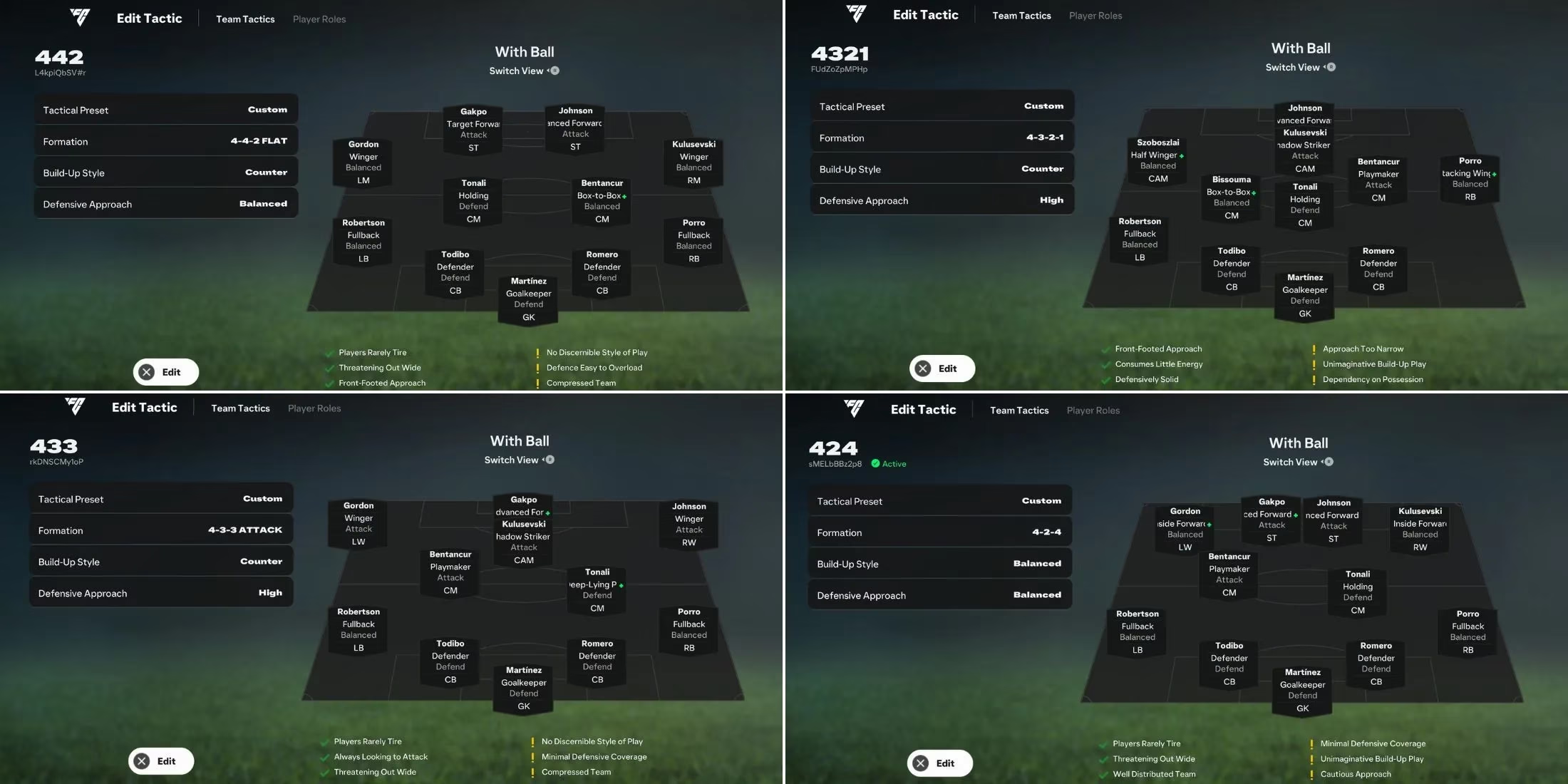
Yet, the heart of this classic system beats in the midfield. ⚽ This is where battles are truly won. A manager requires two elite central conductors: one, a deep-lying poet to bridge the chasm between defense and attack; the other, a relentless sentinel poised to snuff out the sparks of opposition counter-attacks. Securing the perfect personnel for these roles is not just important—it is existential. Fail here, and the once-balanced formation crumbles, leaving a manager adrift and overwhelmed in the crucial center of the park.
For those who crave sheer, unadulterated firepower, the 4-2-4 emerges as a thrilling, if perilous, siren call. A direct evolution of the 4-4-2, it capitalizes on the supreme effectiveness of wing play in the current meta. The vision is one of overwhelming force: two jet-heeled wingers stationed high alongside a predatory strike pair, creating a relentless, four-pronged assault that can suffocate any defense in the final third.
Such glorious attacking promise, however, is mortgaged against defensive stability. The cost is a lonely, exposed midfield duo tasked with holding the center almost single-handedly while their wide compatriots raid forward. This is the essence of high-risk, high-reward—a formation for the bold, perhaps deployed in moments of desperate need or by those with unshakable faith in their defensive discipline.
Then there is the survivor, the adaptable legend: the 4-3-3. Having weathered every tactical storm, it offers a sanctuary of balance. Among its variations, the 4-3-3 (4) shines brightest in EA Sports FC 25, presenting a canvas of incredible flexibility. It paints a picture of harmonious strength across all zones.
The structure provides a formidable presence in both defense and attack. A trio of midfielders can weave intricate passing patterns, releasing through balls to pacy wingers who stretch the play, creating vast, inviting spaces for a lone striker to exploit. It is, quite simply, a universal setup. Whether a manager's philosophy is rooted in possessive control or devastating counter-attacks, the trusted 4-3-3 offers a pathway to execute it all with grace.
Evolution has touched every corner of the game, and the 4-3-2-1 formation is a prime example. Its anatomy has been redesigned, now featuring two creative attacking midfielders (CAMs) behind a single striker, a shift from the classic three-forward line. While this change initially drew disappointment from purists, the formation remains a potent, if specialized, weapon—especially when the correct player roles are assigned.
Its identity is unmistakably aggressive. Attacking wing-backs provide width, while the midfield trio seeks to dominate the center. The trade-off is a palpable defensive vulnerability, with no dedicated defensive midfielder and advancing full-backs. Yet, for the confident, assertive manager, this setup is a tool to seize the initiative, dominate territory in the opponent's half, and win games decisively on the front foot.
For masters of midfield control, the 4-1-2-1-2 (Narrow) offers a focused, intricate ballet. This formation turns its gaze inward, aiming to dominate the very soul of the pitch through a compact, diamond-shaped midfield core. It is the realm of quick, intricate passing routines and absolute possession control.
With such concentrated strength in the middle, the wing-backs are liberated to become auxiliary wingers, marauding down the flanks to deliver overlapping runs and crosses for the two strikers operating in the box. Defensively, it is surprisingly robust; the central defensive midfielder acts as a vigilant shield, seamlessly dropping into the backline when the wing-backs venture forward.
The primary caution lies in the wide areas, which can be exposed to swift counter-attacks. This, however, is a vulnerability with a solution. A simple tactical adjustment—instructing the wing-backs to adopt a more conservative position—can seal the flanks and funnel all play through the team's area of greatest strength: the bustling, controlled heart of midfield.
| Formation | Key Strength | Primary Weakness | Best For |
|---|---|---|---|
| 4-4-2 | Perfect Balance & Transitions | Demanding Midfield Requirements | Traditionalists & Balanced Play |
| 4-2-4 | Overwhelming Attacking Pressure | Defensive Fragility | High-Risk, High-Reward Strategies |
| 4-3-3 (4) | Ultimate Flexibility & Control | Can be predictable if not varied | All Playstyles (Possession & Counter) |
| 4-3-2-1 | Central Dominance & Attacking Creativity | Vulnerable on the Counter | Confident, Possession-Based Managers |
| 4-1-2-1-2 (Narrow) | Midfield Control & Compact Play | Exposed Wide Areas | Tactical Masters & Possession Zealots |
In the end, the formations of EA Sports FC 25 are not just shapes on a screen; they are philosophies. They are narratives waiting to be written with every pass, tackle, and goal. The successful manager in 2026 is not the one who simply copies a meta, but the one who understands the rhythm of these tactical frameworks, who can listen to their squad's strengths, and who can adapt the ancient geometry of football to the modern, dynamic demands of the virtual pitch. 🏆 The right formation is the first, and perhaps most important, step on that journey.
Of course, a formation is only as potent as the players who execute it. A perfectly calibrated 4-1-2-1-2 is useless without a defensively astute anchor and a pair of strikers with predatory instincts, just as a fluid 4-3-3 demands wingers with explosive pace and relentless stamina. This is where the modern virtual manager must evolve beyond pure tactics and into squad building, systematically acquiring the right personnel to breathe life into their chosen system. The journey from tactical blueprint to on-pitch dominance is often paved with player upgrades that allow your philosophy to reach its full expression.
For those looking to accelerate their progress and secure the elite talent required to make these formations truly unstoppable, building the Ultimate Team is now easier than ever. Without spending countless hours grinding matches, you can use Lootbar to secure FC 25 Coins quickly and safely. It is the smart, efficient way to bridge the gap between the tactical ideas in your head and the world-class squad on your screen, ensuring that when you step onto the virtual pitch, your strategy is backed by the talent it deserves.
Comments